Smart Factories: Beyond the Hype
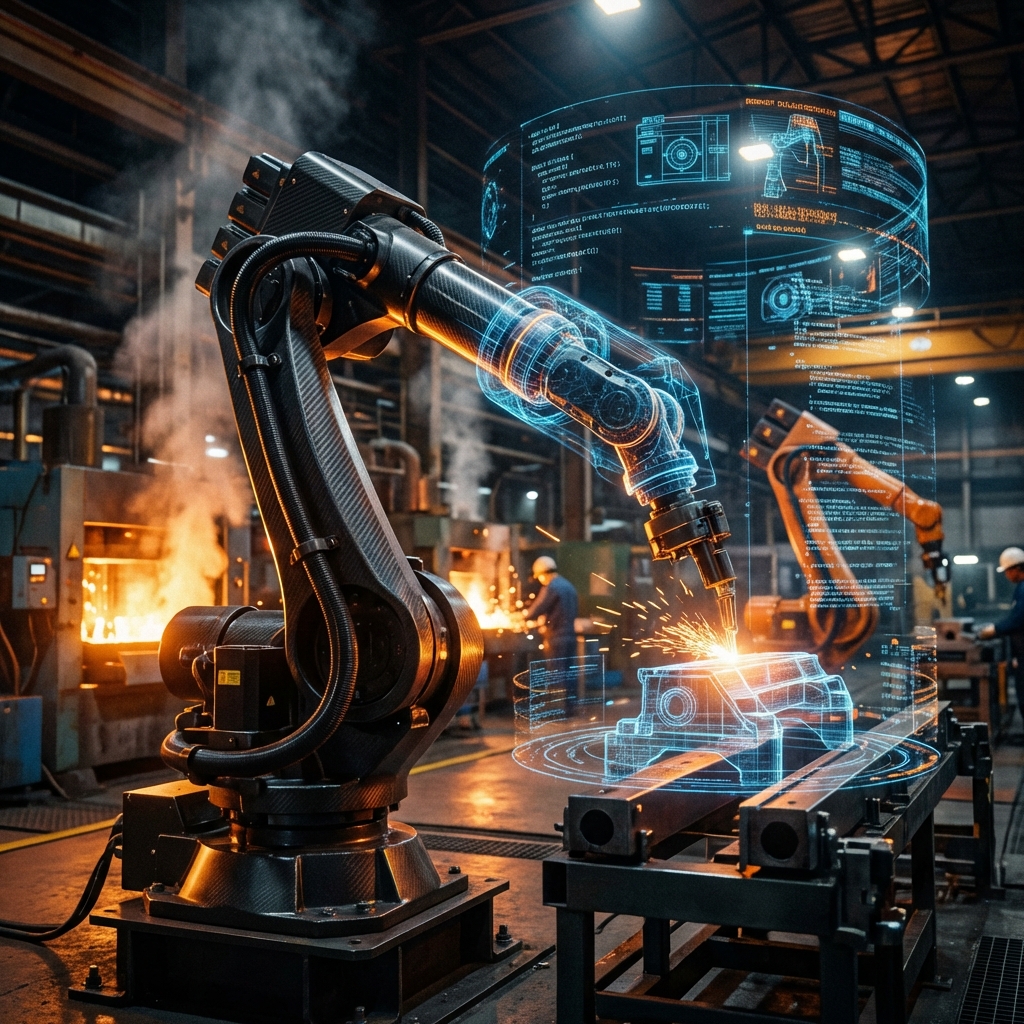
Lessons learned from deploying RedStore in aerospace manufacturing. Why 'Thin Client' IoT is the key to scalability in harsh industrial environments.
True Smart Factories abandon heavy edge processing in favor of 'Thin Client' IoT architectures. By streaming raw sensor data directly to centralized or agentic processing engines, aerospace and automotive manufacturers ensure 99.9% asset visibility without the catastrophic maintenance overhead of deploying complex servers on every factory floor.
The initial promise of 'Industry 4.0' painted a picture of perfectly automated factory floors, where every robot arm, conveyor belt, and power tool thought for itself. This vision drove a decade of massive capital expenditure into what we call 'Thick Edge' computing—deploying high-powered, expensive servers directly into harsh industrial environments to process data locally.
In practice, this approach failed to scale. While placing an AI inference server next to an assembly line sounds cutting-edge, the reality of maintaining fragile IT hardware in environments choked with metal dust, electromagnetic interference, and extreme vibrations proved financially ruinous. Companies found themselves spending more time managing the tracking servers than managing the actual production line.
What is a 'Thin Client' IoT architecture in a Smart Factory?
A 'Thin Client' IoT architecture strips the processing burden away from the physical factory floor. Sensors act solely as 'dumb' collection points, instantly pushing lightweight telemetry—like raw RFID scans or BLE heartbeats—to the cloud or a Sovereign Digital Twin for complex computation and decision-making.
At RedBite, our deployments in elite aerospace manufacturing environments taught us a critical lesson: complexity at the edge is the enemy of reliability. When tracking highly regulated components like titanium fan blades or calibrated torque wrenches, the sensors deployed must be physically robust and functionally simple.
Instead of asking an RFID reader portal to determine if a fan blade is authorised to enter the curing oven, the 'Thin Client' reader simply acts as a conduit. It blindly captures the EPC (Electronic Product Code) and the timestamp, then instantly offloads that string of characters via a secure MQTT stream to the central processing engine. The central engine (or the asset's digital twin) evaluates the business logic and sends a binary command back down: *Unlock the door*, or *Sound the alarm*.
This architectural pivot reduces the cost of the edge hardware by up to 80% and allows for centralized, over-the-air updates to the business logic without requiring a technician to physically touch hundreds of scattered factory floor readers.
How do Smart Factories track work-in-progress (WIP) efficiently?
Aerospace Smart Factories track work-in-progress (WIP) by establishing a zero-touch mesh of Passive RFID choke points and ultra-wideband (UWB) zones. This hybrid net ensures every component's location and dwell time are precisely logged without requiring workers to manually scan barcodes at every workstation.
In high-value, slow-moving manufacturing (like building an airplane or a satellite), the primary metric is 'dwell time'—how long a component sits idle waiting for the next step in the assembly process. Legacy processes rely on workers scanning a barcode on a paper traveler document when they start and finish a task. This human-in-the-loop tracking is prone to error; workers frequently forget to scan, leading to 'blind spots' that plague the production schedule.
To construct a true Smart Factory, visibility must be ambient. By embedding durable, high-temperature Passive RFID tags into the bespoke tooling and the physical carriers holding the raw materials, the factory itself becomes the scanner. As a cart carrying a jet engine turbine moves from station A to station B, it passes underneath fixed antenna arrays. The system passively logs the movement, permanently updating the component's digital passport and triggering the next stage in the Just-In-Time (JIT) material delivery queue.
Why is data interoperability the biggest hurdle to Industry 4.0?
The greatest barrier to Industry 4.0 is the 'data silo' effect created by disparate legacy equipment. Manufacturers cannot achieve true automation until they deploy semantic protocols, like the UNTP, that translate proprietary machine telemetry into a universal, machine-readable language.
Hardware is rarely the bottleneck; it is the software translation layer. A modern factory might contain robotic welders from KUKA, PLCs from Siemens, and assembly-line vision systems from Cognex. Each of these machines speaks a proprietary digital dialect. Collecting this data is easy, but making it interoperate so that the welding robot can mathematically "trust" the location data provided by the vision system requires a unifying standard.
This is why the transition toward Agentic Supply Chains and Sovereign Digital Twins is critical. By forcing all shop-floor hardware to report its state through standardized, vendor-neutral protocols, we break the data silos. The factory ceases to be a collection of isolated machines and becomes a single, cohesive, self-regulating organism.
Interested in this topic?
Discuss how Smart Factories: Beyond the Hype applies to your business.
Get in Touch