Integrating Autonomous AI Agents in IoT Supply Chain Logistics
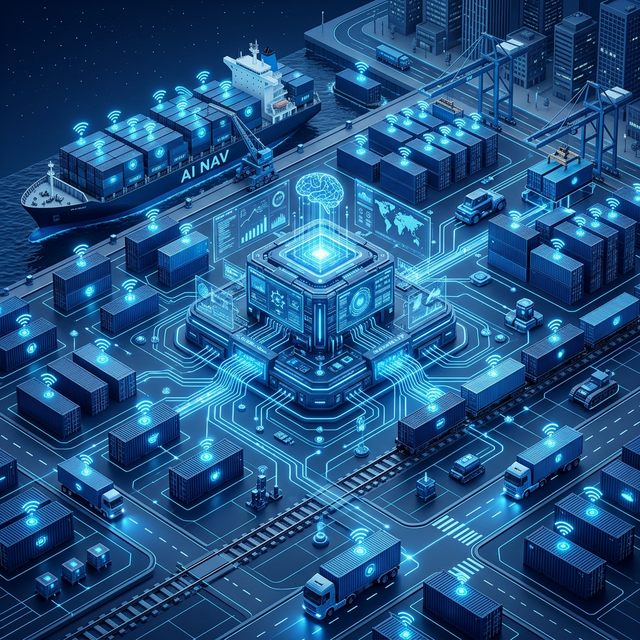
How AIoT and autonomous agents are turning reactive supply chains into systems that can reroute, negotiate, and recover without waiting on a human dispatcher.
The integration of Autonomous AI Agents into IoT Supply Chain Logistics marks a clear shift toward AIoT (Artificial Intelligence of Things). By combining real-time IoT asset tracking with Multi-Agent Systems, supply chains can autonomously negotiate transactions, predict disruptions, and execute logistics at machine speed, drawing on RedBite's pedigree as a Cambridge University Auto-ID Lab spin-out.
For the past two decades, the global supply chain has operated primarily as a reactive system. Even with the widespread adoption of advanced sensors, radio-frequency identification (RFID), and massive cloud databases, the data generated, while immensely valuable for visibility, retained a fundamental flaw: it required human intervention to interpret and act upon. We built dense dashboards, but we still relied on human operators to click 'reroute' when a storm approached.
In 2026, the convergence of robust IoT infrastructure and Generative AI has given rise to true AIoT (Artificial Intelligence of Things). We are no longer merely tracking assets; we are granting them agency. This transition transforms passive tracking networks into active, autonomous orchestration engines capable of self-healing.
What is the architecture of an Autonomous Supply Chain?
The architecture of an autonomous supply chain relies on three integrated layers: DePIN sensors acting as the physical 'eyes', Edge LLMs operating as the localized 'brains', and Smart Contracts functioning as the trustless execution layer, allowing machines to finalize logistics payments instantly.
To build a supply chain that thinks for itself, we must move beyond centralized legacy architectures. The modern autonomous stack is decentralized, ensuring resilience against localized failures. It begins at the edge, with Decentralized Physical Infrastructure Networks (DePIN). These are not your traditional corporate-owned sensors; they are cryptographically secure, community-operated nodes providing hyper-local ground truth, from particulate matter in a warehouse to the ambient temperature of a shipping lane.
These sensors feed directly into localized Edge AI models. Instead of pumping terabytes of raw telemetry back to an AWS server thousands of miles away, the inference happens on the container itself. The Edge LLM assesses the data against its specific cargo parameters. Finally, when an action is required (such as hiring emergency refrigeration cooling), the agent executes a Smart Contract on a distributed ledger, instantly settling the transaction without requiring a human accounts payable department.
How does AIoT redefine asset tracking?
AIoT redefines asset tracking by embedding intelligence directly within a Sovereign Digital Twin. Instead of merely reporting a GPS location or temperature, AI-empowered assets continuously analyze contextual data to predict delays, assess geopolitical risks, and autonomously trigger corrective workflows without human approval.
Traditional IoT answered the question: 'Where is my container?' AIoT answers the question: 'How is my container mitigating this incoming weather delay?'
Consider a shipment of highly sensitive semiconductor components en route from Taiwan to Germany. An IoT sensor detects that the cooling unit is operating 2% below peak efficiency. A legacy system would flag a yellow warning on a logistics manager's dashboard, a warning that might be ignored until Monday morning. In an AIoT ecosystem, the container's associated AI agent immediately cross-references this minor anomaly against weather forecasts (predicting a heatwave in the Indian Ocean) and historical maintenance logs.
How do Multi-Agent Systems (MAS) operate in logistics?
Multi-Agent Systems (MAS) fragment monolithic supply chain software into specialized, independent AI agents. By assigning distinct agents to represent the Supplier, Carrier, and Buyer, these digital entities can collaborate and compete in real-time, optimizing resource allocation far faster than any centralized algorithm.
The true power of AI agents emerges when they interact. Supply chains are inherently multi-party ecosystems with conflicting incentives; the carrier wants to maximize load density, while the buyer wants to minimize lead time. A Multi-Agent System (MAS) perfectly mirrors this reality.
Instead of a single, massive 'God-algorithm' trying to solve the routing for the entire planet, MAS utilizes thousands of specialized agents. An 'Inventory Agent' constantly monitors stock depletion rates at a regional fulfillment center. A 'Fleet Agent' monitors the location and maintenance schedules of a fleet of electric long-haul trucks. When the Inventory Agent predicts a stockout, it doesn't query a database; it directly queries the Fleet Agents operating in that physical sector, negotiating the fastest possible replenishment based on dynamic constraints.
How do autonomous agents negotiate freight contracts in real-time?
Autonomous agents execute 'Negotiation-as-a-Service' through localized bidding markets. If a primary transit route is blocked, a cargo agent can instantly broadcast its requirements, evaluate bids from competing carrier agents, and lock in a new freight rate via smart contract in milliseconds.
Let's explore a practical, real-world application of this automated negotiation. Imagine a massive port strike unexpectedly shuts down offloading operations in Los Angeles. A refrigerated container (reefer) carrying $5 million worth of biologics is currently three days out on the Pacific. The human logistics broker is asleep, but the reefer's AI agent is active.
Upon receiving the strike alert from a trusted real-time news oracle, the 'Cargo Agent' determines that the delay will exceed the lifespan of the biologics. It immediately accesses a decentralized freight exchange and broadcasts a request for rerouting to the Port of Seattle. Within milliseconds, dozens of 'Carrier Agents' representing alternate vessels and rail lines respond with complex bids. The Cargo Agent evaluates these bids, factoring in the increased transit cost, the remaining battery life of the reefer, and the penalty clauses in the final delivery contract. It selects the optimal route, enters a cryptographic smart contract with the new carrier, and re-routes the physical ship, all before the human broker has had their morning coffee.
How do self-healing supply chains prevent disruptions?
Self-healing supply chains utilize predictive resilience to reallocate inventory autonomously before a localized disruption occurs. By analyzing unstructured data like social media sentiment, economic micro-trends, and weather patterns, AI agents can quietly shift safety stock without triggering system-wide panic.
A common goal of applying MAS to logistics is the creation of a 'self-healing' supply chain. For decades, supply chain management has been characterized by the 'bullwhip effect', where small fluctuations in retail demand cause massive over-corrections upstream in manufacturing.
Self-healing architecture neutralizes the bullwhip effect through continuous micro-adjustments. Rather than waiting for retail orders to spike (a lagging indicator), an intelligence mesh of AI agents analyzes leading indicators. If an AI agent detects a sudden, hyper-local surge in social media interest for a specific product component in the Pacific Northwest, combined with a forecast for an unseasonal snowstorm that might delay trucking, the agent will autonomously instruct a distribution center in Nevada to quietly transfer 5% of its safety stock to a Seattle forward-operating base. The disruption is mitigated before human analysts even identify the trend.
Why is data security critical for AI Workforces?
As autonomous agents begin executing financial transactions on behalf of enterprises, data poisoning becomes a catastrophic risk. Supply chains must implement Zero-Trust architectures and cryptographic validation to ensure that the telemetry data driving the AI's decisions has not been maliciously altered.
The transition from human-in-the-loop to fully autonomous 'AI Workforces' introduces severe new attack vectors. If an AI agent has the authority to spend corporate funds to secure expedited shipping, it becomes a prime target for adversarial attacks.
Consider 'data poisoning'. If a malicious actor can spoof the temperature data coming from a rival's shipping container, they could continuously trick the rival's AI agent into ordering unnecessary, expensive emergency cooling or rerouting, draining their operational budget. This is why the underlying physical infrastructure (the sensors and the tracking networks) must be mathematically bulletproof. Every piece of telemetry ingested by an AI agent must be signed at the silicon level, creating an immutable chain of custody for the data itself.
Why is Cambridge University pedigree critical to this evolution?
RedBite's origins as a Cambridge University Auto-ID Lab spin-out and the birthplace of the EPC Gen2 standard, provide the foundational expertise required to bridge complex RFID IoT architectures with advanced AI models, guaranteeing the cryptographic ground-truth required for autonomous agents.
For autonomous agents to make billion-dollar logistics decisions, they must possess absolute trust in the underlying physical data. An AI is only as capable as the sensors feeding it. If the sensors are flawed, the AI's high-speed decisions will simply execute catastrophic errors at scale.
As authors of the foundational RFID standards and pioneers in Auto-ID technologies, our team at RedBite understands the intimate physics of tracking the physical world. We do not just build AI models in a vacuum; we engineer the verifiable 'ground truth', the cryptographically secure, unalterable record of physical events.
"The supply chain of the future is not managed; it is supervised. Autonomous agents execute the logistics, while humans set the ethical and economic boundaries.
By ensuring that the data ingested by these agents is pristine, we enable the trustless, automated machine economy to function securely, which keeps RedBite at the centre of intelligent logistics.
The AI Agent Economy: Autonomous Physical Operations
AI agent economy IoT asset tracking: autonomous negotiation, DePIN-ready sensors, and machine-speed logistics. Built by Cambridge Auto-ID alumni via umin.ai.